The difference between Finnish thermowood and Iranian thermowood
Introduction
Thermowood is one of the amazing phenomena of the world of wood; A natural material that turns into a resistant, durable and beautiful product with temperature and steam technology. But there is always an important question for designers and employers: What is the difference between Finnish thermowood and Iranian thermowood?
In this article from Azarwood, as one of the specialized references of thermowood production and implementation in Iran, we intend to examine these differences from a scientific, technical and even sensory angle; So that your choice is not just an economic decision, but a choice based on real knowledge and understanding of wood.
Origin and production process
Finnish thermowood is obtained from softwood species of cold northern Europe, such as Scandinavian pine. Due to the slow growth, the wood of these trees has a high density, and when it is placed in the thermo process, its cellular structure becomes completely stable and uniform.
In Finland, this process is carried out under the supervision of the official ThermoWood Association; Where every step from drying to steaming is recorded with precise and controlled temperatures. The result is wood with a moisture content of less than 4%, high hardness and excellent resistance to weather changes.
In Iran, the production of thermowood is done more than domestic or imported Russian wood species. Brands such as Azerwood, using fully automatic Finnish ovens and precise temperature control, have managed to bring the final quality to the level of European models. The main difference is not in the type of process, but in the biopattern of raw wood; Because the density of Iranian wood is a little lower than the Finnish type, but with accurate thermal restoration and standard lubrication, the final performance is very close.
Differences in color and texture
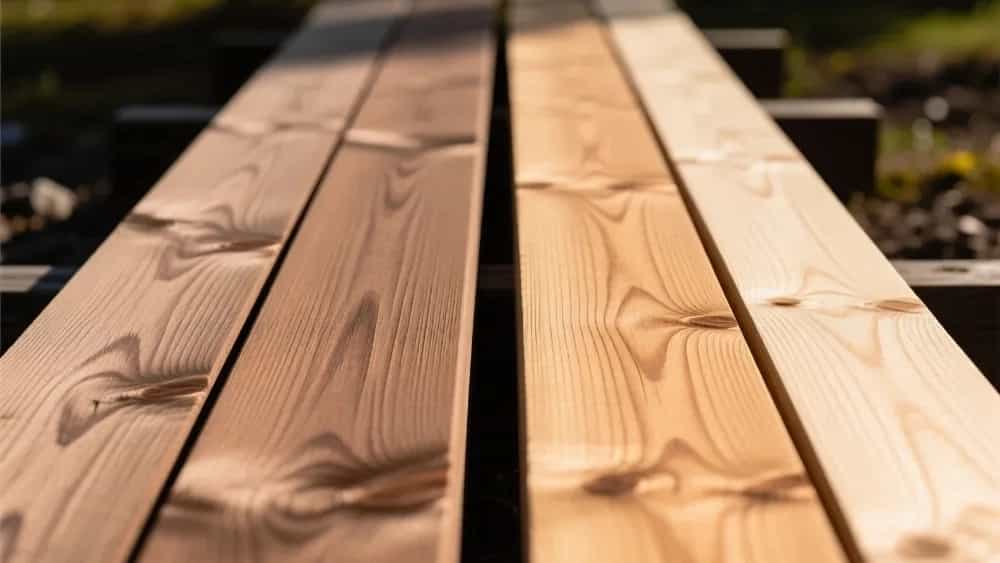
Finnish thermowood usually has a lighter and amber color; Its surface is silky and the wood lines are regular and soft. This look is popular for modern, minimal spaces and Scandinavian architecture projects.
In contrast, Iranian thermowood is usually warmer and darker, giving the project a classic and intimate feel. By carefully adjusting the thermal cycle and using pure steam without chemical additives, Azar Wood has been able to bring the natural color of Iranian wood closer to the Finnish luxury range. This point is one of the honors of Azarwood's exclusive technology; Wood without pigment, completely natural but at the same level as export thermowood.
Differences in physical resistance
Moisture, pests and temperature changes are natural enemies of wood. Finnish thermowood has an average dimensional stability of up to 95%, which means that there is almost no deformation in the conditions of rain, sun and frost. In typical Iranian samples, this stability is about 85%.
However, in Azarwood, by resetting the thermo and lubrication devices at a higher temperature, the resistance rate has improved up to 92%, and in the environmental tests of the north of the country, the performance is completely similar to that of Finland. This level of quality is the result of technical experience and more than 100 executive projects of the Azar Wood brand throughout Iran.
Durability and longevity
Finnish thermowood has a useful life of between 30 and 40 years according to international standards. In Iran, the lifespan of modified wood is defined as between 20 and 25 years. But in Azerwood products, with nano coating and the use of special UV protective oil, the lifespan has increased to more than 35 years. This result is confirmed by official tests of resistance to sunlight and humidity in the cities of Rasht and Isfahan and is recorded in the Azarwood product certificate.
Simply put, in projects with regular maintenance and periodic lubrication, Azar Wood Iranian thermowood can maintain its beauty without change for three decades; This number is quite excellent for Iran's climatic conditions.
Difference in price and economic value
Finnish thermowood is almost twice as expensive as domestically produced thermowood due to direct import and currency fluctuations. This price difference always makes the customer hesitate between "world quality" and "economical savings".
But in the Azar Wood brand, by using thermo-Finnish technology inside the country, the produced Iranian wood not only competes with the Finnish type in terms of appearance and durability, but it is offered about 40% cheaper. This issue has made commercial, villa and building facade projects able to experience a European experience at a reasonable cost.
In fact, Azarwood has turned Iranian thermowood from a local product into an export product with high economic value.
The difference in the sense of space and design style
The appearance and feel of each wood has a direct psychological effect on the space. Finnish thermowood gives a sense of coldness and Scandinavian comfort; Similar to minimal, glass and metal architectures.
On the other hand, Iranian thermowood has a special warmth that can be seen in villa spaces, wooden roofs and interior design with wonderful classic elements. Knowing the behavior of wood in different climates of Iran, Azar Wood has designed different versions of Iranian thermowood for each region — from light thermowood for northern areas to dark thermowood resistant to desert climates.
This approach of "climate appropriateness" is considered one of the unique features of Azarwood brand, which does not exist in similar foreign products.
A smart choice with a practical look
Many employers look for a balance between cost and quality when deciding between Finnish and Iranian thermowood. The thing to know is that both types of wood have the same base in terms of chemical structure; The difference is in the stage of implementation and processing, not in the nature of the material.
Using precision Finnish equipment, Iranian wood can provide the same efficiency and beauty, especially when a manufacturer like Azarwood stands behind it.
In projects where visual sensitivity and long-term durability are important, Azar Wood even offers the Finnish-Iranian combination; A view with exposed Finnish wood and Iranian wood in indirect areas, in order to maintain beauty and durability while reducing costs.
summary
Finnish thermowood is the global standard of this industry, but domestic technology in recent years, especially in the Azar Wood brand, has made the quality gap to a minimum.
If your goal is to have a wood with originality, durability of several decades and a reasonable cost, Azarwood Iranian thermowood is a completely smart choice.
But if you have an international project that requires imported authenticity, Finnish thermowood with Azar Wood's official guarantee will be the best option.
Finally, the difference between the two is in the name and origin; Not in user experience.
The beauty, stability and natural feeling of wood are the things that Azar Wood gives you with unceasing precision in the production and oiling process — wood that comes from the heart of nature, but is reborn with the knowledge of industry in Iran.