Everything you need to know about thermo wood implementation
Introduction
Thermowood is not just a type of material, but an upgraded version of nature: wood modified with thermal technology to withstand moisture, heat, sun and time.
But the beauty and durability of Thermowood does not depend only on the quality of the wood; Correct execution is what brings the project from normal to professional and luxury level.
In this article, the Azarwood brand explains step by step all the basics of implementing Thermowood — from preparation to maintenance, so that architects and contractors know how to install this valuable wood with engineering precision.
Choosing the right material
The first step in the successful implementation of thermo wood is to choose the type of wood. Thermowood is divided into two main classes depending on the user:
– Class D (Thermo-D): suitable for indoor spaces and areas with controlled humidity.
- Class A (Thermo-A): suitable for outdoor spaces such as facade, floor, terrace or gazebo.
In the Azar Wood production line, heated Finnish pine, sparrow tongue and fir wood are prepared with a final moisture content of less than 6% so that they do not show any sudden reaction to the ambient air during the installation stage.
infrastructure; The foundation of real durability
Substructure in Thermowood is the most important point that determines the final quality. If the foundation is not accurate, no amount of oil or anti-rust screws can save the wood.
For facade and floor spaces, the foundation profile should be galvanized or corrosion-resistant aluminum. In domestic projects, dried wood with appropriate density (450-500 kg/m³) is usually used.
The distance between the profiles should be 40 to 60 cm so that the weight is distributed and the wood resists pressure and vibration.
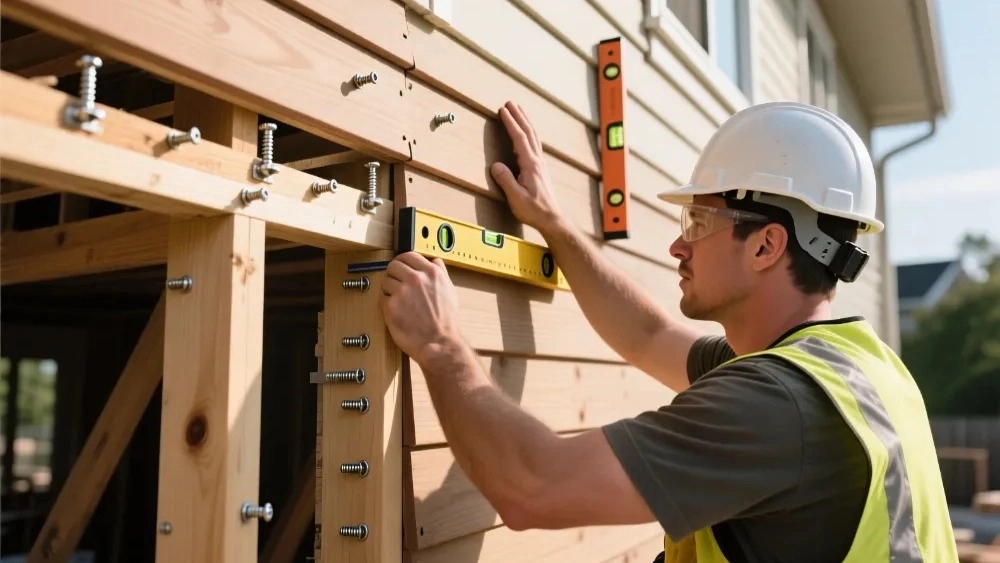
Azer Wood uses a laser level in its special system to set the level of the substructure completely horizontally without a millimeter difference.
Ventilation and water exit
If the installation space is outside, ventilation and drainage are critical. There should be a distance of at least 1 cm between Thermowood and the wall for air flow so that moisture does not collect between the surfaces.
In the implementation of the thermo floor, in the direction of the water slope, the foundation strips must first be installed at the right angle (about 1% slope) so that the water can be drained without lasting.
In projects in the north of the country, Azar Wood implements a ventilated substructure system with an aluminum mesh profile so that the air flow is permanent and drying, as a result, the useful life of wood increases up to two times.
Choosing the right screws and fittings
In the implementation of thermo wood, the choice of screws is more important than the wood itself! Using ordinary galvanized screws is a common mistake that causes rust and blackening around the screw.
Special offer of Azarwood:
- Stainless steel A2 or A4 Stainless Steel screws for outdoor spaces;
- Color coating matching the color of wood for interior spaces;
- Pre-drilled hole to prevent cracking during installation.
In Azar Wood's hidden installation system, special steel clips are attached under the groove of the wood so that no traces of screws can be seen on the surface — the final look will be completely uniform, luxurious and clean.
The difference between horizontal, vertical and diagonal installation
Installation direction determines not only beauty, but also thermal performance and water drainage.
- Horizontal installation: The most common method on the ceiling and wall, with a sense of stretching the space and classic order.
- Vertical installation: suitable for narrow facades or columns, creates a sense of height and dynamism.
- Diagonal or angled installation: For special and modern designs that interact with light, in the Azarwood design office, the angles are accurately calculated with CAD software so that the final model is perfect.
Oiling and final finishing
After the complete implementation, it is time for the stage that determines the appearance and protection of the wood: oiling and finishing.
Azerwood uses natural oils with UV protection. The best options according to the European standard include Oli-Natura High Solid or Osmo UV-Protect.
The oil should be applied in the direction of the grain of the wood with a pen or a special cloth. Two layers of oil with a drying interval of 24 hours is enough to make the surface waterproof and anti-radiation.
In wet or humid areas, it is recommended to renew the oil once every two to three years to keep the surface always fresh.
Ambient temperature control and installation time
Execution of thermo wood should not be done in humidity higher than 18% or temperature lower than 10 degrees Celsius. In this condition, the adhesion of oil and screws becomes weaker and the possibility of warping increases.
Prior to installation, the wood must be left in the project environment for at least 48 hours to acclimate to the local temperature and humidity — something the Azarwood team always does before the actual day of installation, accurately measuring the acclimatization with a digital hygrometer.
Combining thermo wood with other materials
One of the beauties of Thermowood is the possibility of combining it with steel, stone or glass. In double-skin facades, thermowood acts as the outer skin against direct light, and the harder material underneath filters the light.
In interior designs, the combination of thermo wood with hidden light and black aluminum frames is one of the signatures of Azarwood design — a combination of natural feeling and industrial precision in one frame.
Common errors in thermo implementation
Even the best wood loses its quality if installed incorrectly. Some common mistakes to avoid:
- Installation without ventilated space;
- use of ordinary screw;
- Uneven infrastructure;
- Installation without wood moisture test;
- Ignoring the expansion in the change of season.
The technical team of Azarwood controls all these items with an executive checklist from beginning to end so that no technical error remains in the output.
Maintenance and service after installation
Executing thermo wood is not the end of the job, it is part of the maintenance cycle. Azarwood has designed a post-installation service system for its customers:
- annual visit and level test;
- relubrication every three years;
- Control screws and color;
- Providing a 10-year warranty for dimensional stability.
With these services, the project will maintain the original feel even after years.
summary
Executing thermo wood is a combination of engineering science and artistic elegance. From the foundation to the final oil, each step must be done with care and knowledge to preserve the beauty and durability of the wood.
In Azar Wood projects, all these steps are carried out with international standards, precise tools and decades of experience so that the customer only sees the final result: a perfect, resistant, stable and luxurious wooden surface.